
News
- All
- Green Build
- Training
- Roofing
- Housing
- Projects
- Technology
- People
- Legal
- Events
- Security
- Plant
- Blog
- Products
- Waste
- News
- Jobs
ICF National Conference 2012 16-17 May
 Future Forestry - Meeting the needs of society in the 21st century. CBI Conference Centre, Centre Point, New Oxford Street, London
Did you predict the public’s reaction in February last year to the Government's proposed change in woodland ownership in England? Do you have a clear idea of the international and domestic forces that will shape forestry and forestry businesses over the next decade? Do you know all about carbon trading and how forestry fits in?
We’ve seen the industry's reaction to policy decisions, huge public concern over forest sell-offs, biosecurity challenges, changing planting demands, economic drivers that bring tough financial decisions, increased and often bureaucratic legislation, and a potential long-term skills shortage on the horizon. The list goes on.
Construction National blog: 03/05/2012
 The Royal Institution of Chartered Surveyors has been busy over the past few weeks. On 24 it published new quantity surveying and construction standards – the Black Book – together with New Rules of Measurement. The institution described it as: "One of the most significant launches by RICS in the past 30 years."
The new standards reflect the way the industry is changing and has changed over the past decade. A construction site is not – and doesn't look – the same place as it did a decade or so ago. Gone are the huddles of men pouring over flapping pieces of paper, their cigarettes glowing in the biting wind.
Now the men – and women – in charge on site all have separate access to documentation via tablet or smartphone (even a laptop is passé) and the entire site is a no-smoking area. BIM is the new way of integrated working.
Construction National blog: 25/04/2012

The country has sunk once again into recession, according to figures published today (25 April) by the Office of National Statistics, that august body by whom I was once – briefly – employed. It is what they call a 'double-dip' recession: two quarters of contraction following one quarter of growth. The main culprit was the construction industry, with a 3% decrease in output during the first quarter of this year.
Dave said he wasn't going to try to excuse the figures or explain them away. That, at least, is a first for a politician. The deputy chair of sector skills body ConstructionSkills, Judy Lowe, was quoted as saying: "The huge cuts to public spending – 25% in public sector housing and 24% in public non-housing and with a further 10% cuts to both anticipated for 2013 – have left a hole too big for other sectors to fill."
Those of us who count cranes for a living have been wondering for a lot longer than six months what must be holding up all the buildings under construction. The answer is 'nothing' – there aren't any buildings under construction. Housebuilding has ground to a halt, with a massive downturn in the social housing sector more than cancelling out modest increases in the private sector. According to figures released by the NHBC, February saw a 58% drop in the number of new homes registered in the public sector, against a 27% increase in the public sector.
There have been glimpses of light. New transport projects are in the pipeline or underway, such as the extension of the Metrolink in Greater Manchester and the announcement of an electrification scheme for the trans-Pennine routes. Less successful was the launch of the new, £100m tramway in Blackpool. The first tram to set off from Fleetwood on 4 April was derailed and the line temporarily closed because of – sand on the tracks! In Blackpool? Well I never.
In the capital, the Crossrail project is expected to employ up to 13,000 people in the next three years or so, while the Underground has been busy upgrading stations and lines to take its new trains.
New hotel building has also seen a veritable boom. Last time I counted there were at least a dozen either recently completed or on site in London alone.
The spur for that, of course, has been London 2012. In fact the Olympic building project has almost certainly kept the construction industry alive, with over 10,000 people employed on the Olympic Park and Athletes' Village at one point in 2010. That was in addition to other venues, infrastructure and aforesaid ancillary activities such as accommodation.
What is going to happen when all that is over. Maybe we should patch things up with Herr Blatter et al and get bidding for the World Cup again. When is the next one available; 2026?
Chris Stokes
Residents blast council over £5k roofing bills
 Pensioners have criticised council bosses after being threatened with bills for “unnecessary” renovations to their flats.
Griffin Estate leaseholders were left “scared stiff” after discovering they each faced paying thousands of pounds for roofing repair works.
Barrow Borough Council sent letters to almost 40 residents on March 28, estimating their respective shares of the cost and giving them 30 days to obtain their own quotes.
Allan Sykes, 66, of Longmynd Avenue, said his initial reaction to his proposed contribution of £5,110 was: “You’ve got no chance.”
Swan New Homes team up with CCSec
 Swan ‘Gliding Smoothly’ with Security Solutions from CCSec! CCSec is delighted to now be working with award winning new homes developer Swan New Homes.
CCSec is providing comprehensive site security to their new Oldchurch Park development in Romford, Essex that consists of 376 apartments and houses with a mixed tenure of private, rented and shared ownership. It is anticipated to be a three year project with the first construction phase already underway.
Armitage Sykes puts together specialist construction group
 A Yorkshire law firm plans to increase its market share, at a time when the Government’s drive to promote localism is expected to lead to more mediation work.
Huddersfield-based Armitage Sykes has launched a specialist construction law team.
The team, which is being officially launched this week, will provide services for developers, contractors and sub-contractors, professional consultants, funders and property agents.
The £3m turnover firm has decided to launch the team in response to the Localism Bill, which aims to ensure that more decisions about housing are taken locally.
Read more: Armitage Sykes puts together specialist construction group
New specialist construction facility for Somerset college
 A new £1.5m construction and mechanisation training facility funded by EDF Energy is to be built by ISG at Cannington in Somerset.
Bridgewater College will then be able to add courses in a range of civil engineering and construction programmes to its existing offering across their Bridgwater and Wylds Road sites, where students already study brickwork, carpentry, electrical installation and plumbing.
There are specialist workshops for each trade, equipped with industry standard tools and equipment, and a range of classrooms with computers and interactive boards.
The Wylds Road Construction Training Centre is also a designated CSCS Health and Safety assessment centre, and will be assisting employers who are looking to join the nuclear supply chain by providing the initial training in Client/Contractor National Safety Group (CCNSG).
Read more: New specialist construction facility for Somerset college
TSB competition for £4m research project
 The government is seeking innovative construction companies and property developers for a £4m research project to develop new ways of building. Technology Strategy Board will invest the cash in a collaborative research and design competition that will fund up to 15 research projects. The projects will explore and test the viability of new ways of working, novel tools, products or contractual arrangements to demonstrate that they improve build consistency, cost-effectiveness, speed and sustainability.
The project is aimed at encouraging the construction industry to collaborate with its supply chain to radically rethink the build process to deliver buildings cost effectively, in volume, at speed, and with very low levels of defects. The competition is targeting contractors, developers and other major procurers of buildings.
Broadmoor Hospital’s £254m redevelopment approved
 West London Mental Health NHS Trust, advised by Oxford Architects and independent design, environment and energy consultants LDA Design, has received planning permission from Bracknell Forest Council, subject to the completion of a Section 106 agreement for the redevelopment and upgrade of Broadmoor Hospital in Crowthorne, Berkshire.
Originally built in 1863, Broadmoor Hospital provides specialist mental health care services within a high secure environment for male patients from London and the south of England. It’s one of three high-secure hospitals in England, and internationally recognised for its specialised work with patients with some of the most challenging mental health needs as well as its research activities.
The redevelopment and planning application lead by Oxford Architects includes 16 wards - ten new, and six existing - providing accommodation for 210 patients within a new secure environment. The redevelopment will also include a new entrance building, central facilities building, a replacement energy centre, new gardens, recreation areas and extensive landscaping.
Read more: Broadmoor Hospital’s £254m redevelopment approved
White Rose Way bridge lifts movie released
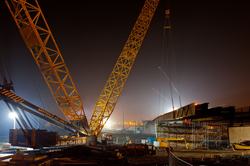 A time lapse movie showing how the nine bridge lifts were completed as part of the Southern Gateway Improvement Scheme along the A6182 White Rose Way has been released.
The short film shows how this major feat of engineering took place using one of the biggest mobile cranes in Europe – the 1200 tonne Sarens Gottwald AK680-3. The lifts took place on days and nights agreed with Network Rail between December and February. The new bridge spans 17 rail tracks including the East Coast Main Line.
Peter Dale, the council’s Director of Regeneration and Environment, said: “Watching this movie shows the complexity of these bridge lifts and why rail track possessions and road closures were required for them to be completed. It is a fascinating film showing views of the works few people were privileged to see.”
To view the film visit: http://youtu.be/vlCS44w8f1U
Construction National blog: 10/04/2012

Following on the heels of the Budget came the much-heralded National Planning Policy Framework, or NPPF: THE hot topic among construction news stories.
It had been flagged in the Budget, before which it had been attacked by an ‘unholy alliance’ of The National Trust and Friends of the Earth for its proposed presumption in favour of ‘sustainable development’ and its (later amended) failure to favour brownfield development.
In the ends nobody was happy, which state of affairs on another subject His Honour Lord Jackson stated could mean it was broadly right. In essence those who favour lots of development welcomed the new framework, although they think that there is still too much restriction; those who don’t, didn’t. They think there is far too little restriction, meaning the entire countryside is on the brink of being dug up and built on.
One area that will almost certainly see a fall in applications is the building of extensions to listed properties. This magazine’s sister publication, Ecclesiastical and Heritage World, will be examining in some depth what the introduction of VAT will mean to the sector. What no-one disagrees with, however, is that a 50-page framework for making planning decisions is better than 3,000 pages.
One of the ‘in’ terms in construction news circles is building information management – BIM. It even has its own trade show. As acronyms go it’s certainly one if the least inspiring; which is a shame, as the development of integrated IT systems covering the entire build process is crucial to a modern construction industry.
In the words of an article published last November in the paper edition of Construction National, BIM is more than just 3D CAD. To find out more go to BIM Show Live at the Business Design Centre in London on 9-10 May.
On a less-than-encouraging note, the HSE has reported that one fifth of sites visited in a national construction site safety initiative failed the safety check. What is even more alarming is that the figure showed “a slight improvement”! Falls from height are a major cause of death or injury in what is one of the country’s most dangerous industries (celebrity ice dancing does not count) and for 20% of companies not to taking the issue seriously enough is a scandal.
One safety issue that has been clarified concerns non-licensed work with asbestos. The changes are in response to an EC view that the UK had not fully implemented the EU Directive on working with the substance. The changes are minor and do not mean a mass exodus of consultants from the Construction Directory on this site.
Chris Stokes